Few self-help books have generated as much enthusiasm, or as much skepticism, as The Secret. Since its publication in 2006, it has sold millions of copies worldwide and introduced countless readers to the idea of the law of attraction. Whether embraced or criticized, its influence on modern self-help culture is difficult to ignore.
When I first read The Secret, I wasn’t entirely sure what to think.
Some of its ideas felt genuinely inspiring, while others seemed difficult to accept without question. The central claim, that our thoughts attract corresponding experiences into our lives, has always been the book’s most debated idea, and one I have never been completely convinced by myself.
Yet despite my reservations, The Secret has remained one of the books I think about most often. Not because I believe the universe responds to every thought we have, but because reading it led me to reflect on something much simpler: the relationship between our mindset, our attention, and the way we move through the world. What truly stayed with me was never the promise that positive thinking alone could transform reality. It was the possibility that the way we think influences what we notice, the opportunities we recognize, and the choices we make every day. That may sound like a subtle distinction, but I think it changes the conversation entirely.
Rather than asking whether manifestation works, I found myself asking a different question.
Can the way we think change the way we act?
The Premise
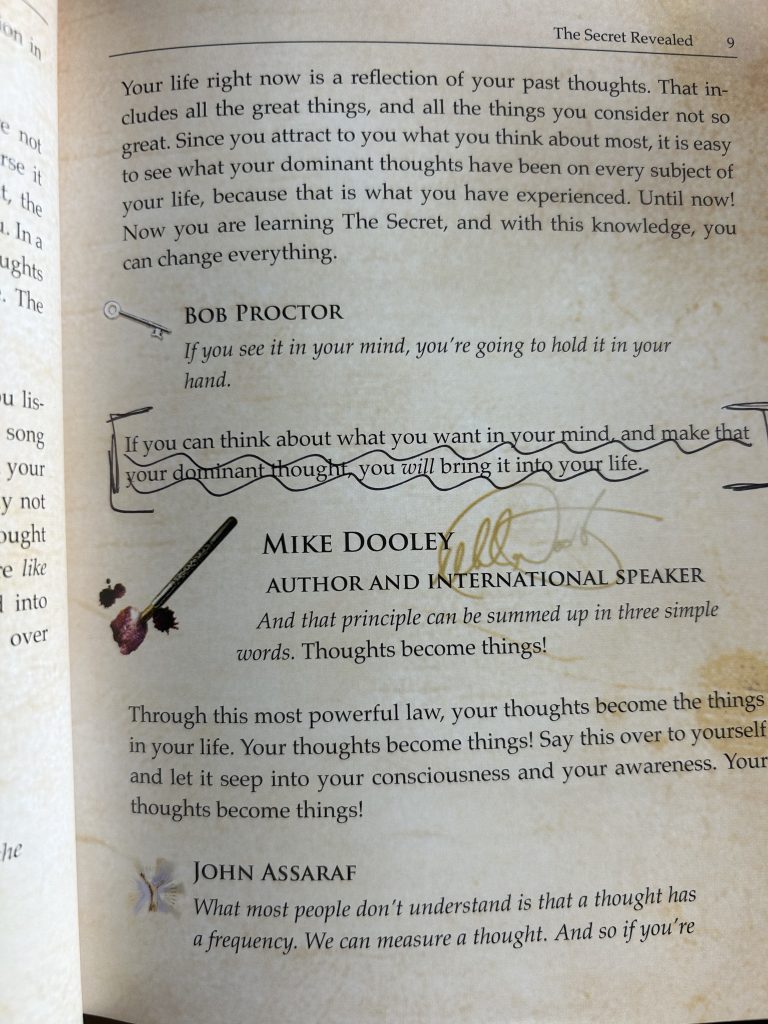
At the heart of The Secret lies a remarkably simple idea. According to Rhonda Byrne, our thoughts are not merely private experiences but powerful forces that shape our lives. The book argues that by focusing consistently on what we want, rather than on what we fear, we begin to attract corresponding experiences, opportunities, and even people into our lives through what it calls the law of attraction.
The idea itself is not new. Byrne draws on a much older tradition of thought that came before The Secret, but she presents it in an accessible and compelling way. Gratitude, visualization, and intentionally directing our attention toward the life we hope to create become the central practices of the book. Rather than dwelling on what we lack or fear, Byrne encourages readers to cultivate a mindset centered on possibility, abundance, and intention.
It is easy to understand why these ideas resonated with so many readers. The possibility that our lives might be shaped, at least in part, by the way we think is both empowering and hopeful. It suggests that, even when we cannot control every circumstance, we are not entirely powerless in shaping the direction of our lives. At the same time, this is also where I found myself beginning to question the book.
Part of me genuinely wanted to believe in the possibility that our thoughts could shape reality in the way Byrne describes. It is an undeniably hopeful idea. Yet there was always another part of me that questioned it. Life is influenced by far more than our mindset. Chance, privilege, circumstances, and the actions of other people all play a role in the opportunities we encounter and the challenges we face. Even so, I couldn’t ignore the number of people who felt that the book had genuinely changed the way they approached their lives. That, more than the promise of manifestation itself, is what captured my curiosity.
Looking Beyond Manifestation
While reading The Secret, I realized that what fascinated me most was not simply the idea of the law of attraction itself, but the questions it raised. Long before picking up the book, I had been reading extensively about psychology, neuroscience, human behavior, and the relationship between our thoughts, beliefs, and experiences. Rather than introducing me to these ideas for the first time, The Secret became another perspective on questions I had already been exploring.
While I am still not convinced by every claim Byrne makes, I found it fascinating that many of the themes discussed in the book, particularly those related to attention, belief, and mindset, also appeared in psychology, neuroscience, philosophy, and spirituality, although often explained in very different ways. That made me less interested in asking whether The Secret was simply right or wrong, and more interested in understanding why so many different disciplines continue to explore similar questions about the human mind.
One of those questions has stayed with me more than any other: how much do our beliefs shape the way we live?
Long before we pursue a goal, apply for a job, move to a new city, or begin learning something unfamiliar, we usually form an idea of what we believe is possible. Those beliefs often go unnoticed because they feel so natural, yet they influence the decisions we make. They shape the opportunities we pursue, the risks we are willing to take, and sometimes even the ambitions we allow ourselves to have.
That naturally led me to think about attention. When we become deeply invested in a particular goal, we often begin recognizing opportunities that were previously outside our attention. We notice conversations that suddenly feel relevant, books that seem to appear at exactly the right moment, or people whose experiences resonate with what we are trying to achieve. The opportunities may have always been there, but our perspective has changed.
This idea has stayed with me far more than the promise that we can simply think our way into a different reality.
Visualization is another example. It is one of the ideas most closely associated with The Secret, yet I have gradually come to interpret it in a different way. Rather than seeing it as a way of attracting a future into existence, I see it as a way of becoming clearer about the future we are trying to build. The clearer our direction becomes, the easier it is to recognize the decisions, habits, and opportunities that move us toward it.
I don’t know whether all of this is best explained through the law of attraction, selective attention, neuroscience, or another framework entirely, but I deeply believe that the way we think influences the way we engage with the world. Believing that change is possible makes us more willing to take the first step toward it. In that sense, our thoughts may not determine everything that happens to us, but they can influence the choices we make and the way we respond to the opportunities that come our way.
Why Do These Ideas Resonate?
When thinking about The Secret, it is difficult to ignore how many people continue to resonate with its most fundamental ideas. I don’t think the answer is simply that people want to believe in manifestation. I think the book speaks to a much older and more universal question: how much influence do we really have over the direction of our own lives? None of us chooses where we are born, the opportunities we are given, or many of the circumstances that shape our lives. At the same time, it is difficult to believe that our thoughts, attitudes, and decisions have no influence at all. Somewhere between those two realities lies a question that has occupied philosophers, psychologists, and spiritual traditions for centuries: how much of our future is shaped by circumstance, and how much by the way we respond to it?
I don’t think The Secret offers a definitive answer to that question, and I am not sure that any single book could. What it does offer is another perspective, one that encourages readers to reflect on the role that belief, intention, and mindset might play in their own lives.
Looking back, I don’t think The Secret changed my thinking because it convinced me that the law of attraction explains everything. It stayed with me because it became part of a much broader conversation that I continue to find fascinating. It reminded me that different disciplines often explore the same questions from different perspectives, each offering its own way of thinking about the relationship between our thoughts and the lives we build.