Why one of classical mythology’s most enduring stories still resonates today.
Few stories have endured quite like Amore e Psiche (Cupid and Psyche). First preserved in writing by the Roman author Apuleius nearly two thousand years ago, it continues to resonate with readers today. What has always fascinated me, however, is not simply its longevity, but the reason it has remained so relevant.
It is often remembered as one of the great love stories of classical mythology. On the surface, it certainly is. It tells the story of a mortal woman and the god of love, exploring themes of trust, betrayal, separation, and reunion. Yet the more I have returned to the myth, the more I have realized that it is about much more than love.
At its heart, Amore e Psiche is a story about transformation. Although the version that has come down to us was written by Apuleius as part of his Metamorphoses, better known as The Golden Ass (L’asino d’oro), the story draws on the rich world of classical mythology. Over the centuries, it has inspired some of history’s greatest artists and thinkers. Antonio Canova immortalized it in marble, Raphael brought it to life in the frescoes of the Villa Farnesina, and countless others have continued to reinterpret it ever since.
What makes it so timeless?
Part of the answer lies in the name of its heroine. In Greek, the word psyche means soul. It was also used to describe a butterfly, a symbol long associated with transformation and rebirth. Seen this way, the myth becomes something very different. It is no longer simply about two lovers overcoming impossible obstacles. It becomes the journey of the soul itself, shaped by curiosity, suffering, perseverance, and, ultimately, transformation. This may also explain why the myth has never really belonged to a single period in history. Every generation seems to find something different within it. Some read it as one of the great love stories of classical mythology. Others see it as a reflection on the human soul. That openness to interpretation may be precisely what has allowed it to endure for so long.
The more I have reflected on the myth, the more I have come to believe that it is not really asking how we find love. It is asking what love asks us to become.
The Story Behind the Myth
At first glance, the story itself seems almost deceptively simple.
Psyche is a princess whose extraordinary beauty draws admiration from far beyond her own kingdom. According to Apuleius, people travel from neighboring cities and distant lands simply to look upon her. Gradually, their admiration begins to resemble worship. Some even start referring to her as a “new Venus,” believing that the beauty once associated with the goddess herself has appeared in mortal form. It is this, more than Psyche’s beauty alone, that provokes Venus’s jealousy.
Determined to punish the young woman, Venus orders her son Amor to make Psyche fall in love with the most miserable man imaginable. Instead, as he approaches her, he accidentally wounds himself with one of his own arrows and falls deeply in love. It is a beautifully ironic moment: the god of love becomes the first victim of his own power.
Their relationship begins under one condition. Psyche must never look upon Amor’s face. Every night he visits her under the cover of darkness, and although she cannot see him, she comes to love him deeply. Encouraged by her sisters’ suspicions and overcome by curiosity, she eventually lights an oil lamp while he sleeps. For the first time she sees that the mysterious stranger is not a monster, but the god of love himself. As she leans closer, a drop of hot oil falls onto his shoulder, waking him. Feeling betrayed, Amor leaves.
From that moment, the story becomes something much more than a tale of love interrupted. Determined to win Amor back, Psyche agrees to undertake four seemingly impossible tasks imposed by Venus. Each one proves more difficult than the last, ultimately leading her to the Underworld itself. It is through these trials, rather than through love alone, that Psyche begins to change.
The Journey of the Soul
If Amore e Psiche were simply a love story, it could have ended the moment Amor fell in love with Psyche. Instead, the longest part of the myth begins only after they are separated. To be reunited with Amor, Psyche is asked to complete four seemingly impossible tasks imposed by Venus. She must sort an enormous pile of mixed seeds, gather golden wool from dangerous rams, collect water from the River Styx, and finally descend into the Underworld to retrieve a box belonging to Persephone. Each task appears impossible, yet Psyche succeeds, not through strength alone, but with patience, humility, and the unexpected help she receives along the way.
These trials do not seem like obstacles designed to delay the story. Instead, they feel like the very reason the story exists.
Psyche does not emerge from them unchanged. Each challenge asks something different of her. She learns discernment instead of acting too quickly, patience instead of force, and courage in the face of uncertainty. By the time she reaches the final trial, she is no longer the same young woman who first entered Amor’s hidden palace. This is the true transformation the myth has been pointing toward all along. Love is not presented as something that rescues Psyche from difficulty. Instead, it is the force that sets her journey in motion, asking her to become someone she could not have been before.
Why the Story Still Resonates
Stories rarely survive for nearly two thousand years by accident. They endure because each generation finds something within them that still feels true.
I think Amore e Psiche continues to resonate because it quietly challenges one of the most common ideas we have about love. We often imagine love as something that arrives and changes our lives overnight. The myth suggests something rather different. Love is not the end of Psyche’s journey, but the beginning of it. Before she can be reunited with Amor, Psyche must grow into the person she is capable of becoming. She learns resilience, patience, and trust, but she also learns that growth rarely happens without uncertainty. Every trial asks something of her, and every challenge leaves her changed. I have always love this concept. It reminds us that transformation is rarely immediate. We often wish we could become more confident, more resilient, or more certain overnight, yet most meaningful changes happen gradually. They are shaped by the challenges we face, the mistakes we make, and the experiences that change us over time.
I think this is one of the reasons why Amore e Psiche has continued to speak to readers for centuries. Beneath its gods, goddesses, and mythical creatures lies something deeply human: the understanding that becoming the person we are meant to be is rarely a straightforward journey.
Why Canova Chose This Moment
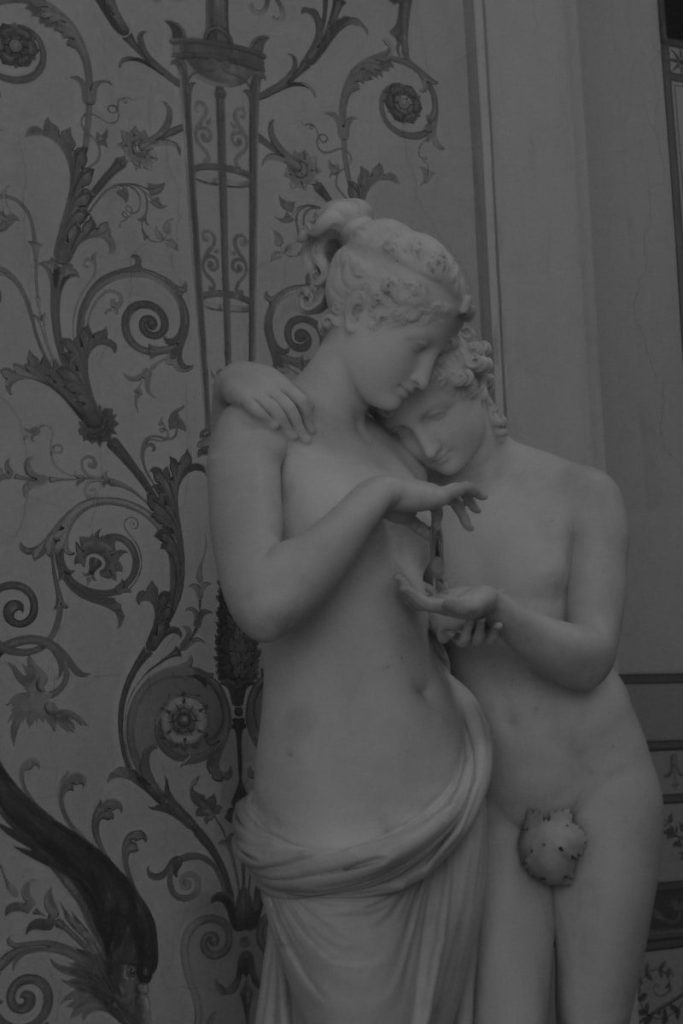
One artist, more than any other, seems to have understood the deeper meaning of Amore e Psiche. The Italian sculptor Antonio Canova transformed the myth into one of the greatest masterpieces of Neoclassical sculpture. His celebrated marble Amore e Psiche is preserved today in both the Louvre in Paris and the Hermitage Museum in St. Petersburg, while the Metropolitan Museum of Art houses the full-scale plaster model created for one of these versions.
What has always fascinated me is not simply the beauty of the sculpture, but the moment Canova chose to represent. He could have depicted Psyche’s extraordinary beauty, Venus’s jealousy, the first meeting between the two lovers, or any one of the four trials that shape the story. Instead, he chose none of them. He chose the moment Psyche awakens.
After her journey to the Underworld, Amor gently revives her with a kiss. Their bodies reach toward one another in an embrace that feels both intimate and restrained. There is no dramatic triumph or theatrical celebration. Everything is remarkably quiet, as though time itself has paused for a single instant. This choice does not seem to be accidental. By the time Psyche awakens, she is no longer the young woman who first entered Amor’s hidden palace. She has endured loss, uncertainty, impossible trials, and the long journey that transformed her. The embrace Canova captures is therefore much more than the reunion of two lovers. It marks the completion of Psyche’s transformation.
That, I think, is what makes the sculpture so extraordinary. Rather than illustrating the beginning of the story, Canova chose the moment in which everything has already changed. Looking at it, I am reminded that Amore e Psiche has never really been only about love. It is a story about growth, resilience, and the transformation that quietly shapes who we become.