I visited the Frick Collection on a Monday morning in April, after several days moving between museums in New York, the Met, the Cloisters, and everything in between. At the Frick, everything felt different. Slower, quieter, more intimate. Maybe it was the timing, but from the moment I walked in that stillness became part of the experience.
The Frick doesn’t feel like a typical museum. It is set inside what used to be the home of Henry Clay Frick, on the Upper East Side. It is not a white gallery space or a large, overwhelming institution. You are stepping into a home. A very grand one, but still a home. And that changes the way you move through it, and the way you look at the art.
The Mansion and Its History
The mansion was designed by Carrère and Hastings and completed in 1914. While it was originally built as a private residence, Henry Clay Frick later arranged in his will for it to become a public museum, describing it as a space dedicated to “encouraging and developing the study of the fine arts.”
Frick, a coke and steel industrialist, became one of the most significant art collectors in American history. He filled his 61-room home with Rococo and Renaissance furniture, alongside an extraordinary collection of paintings and decorative arts, such as Meissen porcelain and Italian bronzes. Works by Bellini, Titian, Holbein, Fragonard, El Greco, Goya, Rembrandt, and Vermeer were placed throughout the house, often in deliberate conversation with one another. Portraits were paired, rival artists juxtaposed, and unexpected dialogues created across centuries.
After Frick’s death in 1919, his wife Adelaide and daughter Helen continued to live in the house until Adelaide’s death in 1931. Helen Clay Frick then oversaw its transformation into a museum, working with architect John Russell Pope on its expansion. The Frick Collection opened to the public in 1935.
From 2020 to 2025, the Frick underwent a major renovation, a five-year project by Selldorf Architects that restored the interiors, added new gallery spaces, and opened the second floor of the mansion to the public for the first time. I visited just one year after it reopened, which meant experiencing the mansion in its most complete and restored form in nearly a century.
Arriving: The Garden Court
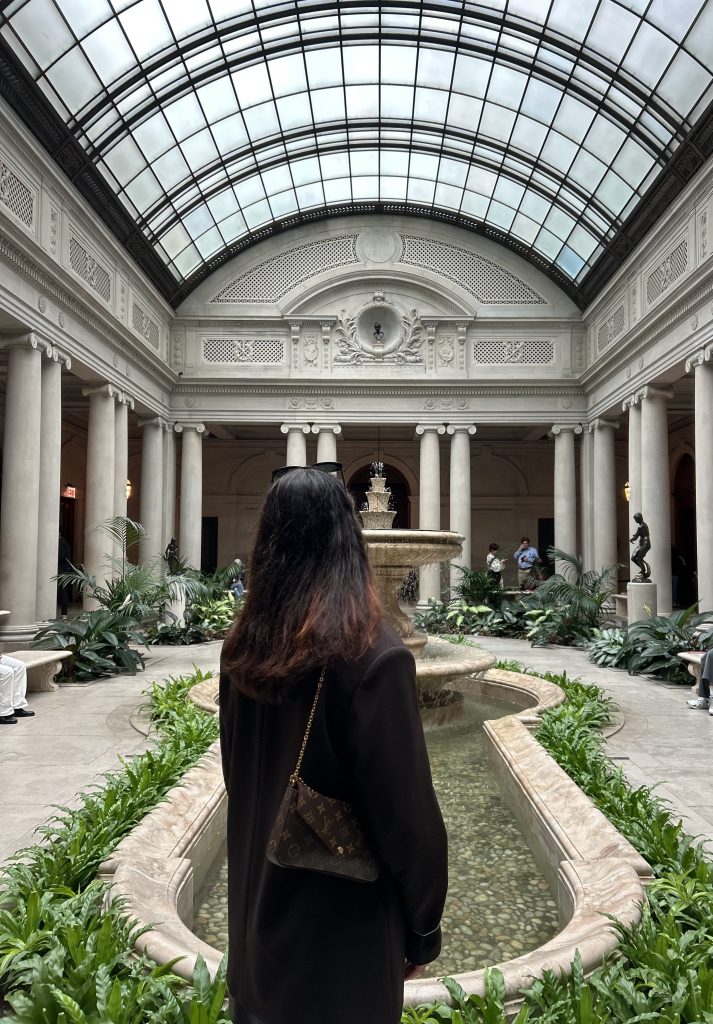
The first thing you walked in is the Garden Court. Designed by John Russell Pope for the museum’s 1935 opening, it transformed what had been an open outdoor carriage court into an elegant enclosed space, columns, symmetrical flower beds, palms, and a fountain under a curved glass roof. It is calm and graceful, and it perfectly sets the tone for everything that follows.
Arriving in a space like that, unhurried, beautiful, completely removed from the noise of Fifth Avenue outside, immediately shifts how you feel.
Moving Through the Rooms
What makes the Frick feel different from other museums is that every room has its own character. The wall colors, the furniture, the decorative objects, the scale, nothing feels accidental. You are not moving through neutral white spaces designed to disappear behind the art. You are moving through rooms that have their own presence, where the art feels part of the space rather than separate from it.
The Library Gallery was one of my favorite rooms. The walls are lined with dark wood, with shelves that include part of Frick’s personal collection. It is not a traditional library, but the presence of books, combined with the fireplace and small decorative details, gives the room a quiet, lived-in feeling. A group of portraits hangs on the walls, and above the fireplace is a portrait of Frick, commissioned after his death. It felt less like a museum room and more like stepping into a private space, where everything had been left almost as it was.
I found myself drawn as much to the interiors as to the paintings themselves. The Boucher Anteroom, for example, felt softer and lighter. Named after the French painter François Boucher, the room reflects his Rococo style, pastoral scenes, delicate colors, and a sense of idealized, almost theatrical beauty.
The West Gallery is the grandest space in the house, with a large skylight and some of the most significant works in the collection. Seeing large paintings by Veronese alongside works by Rembrandt and Ingres stood out. The scale is impressive, and yet the room still feels calm and intentional, never overwhelming.

The Fragonard Room
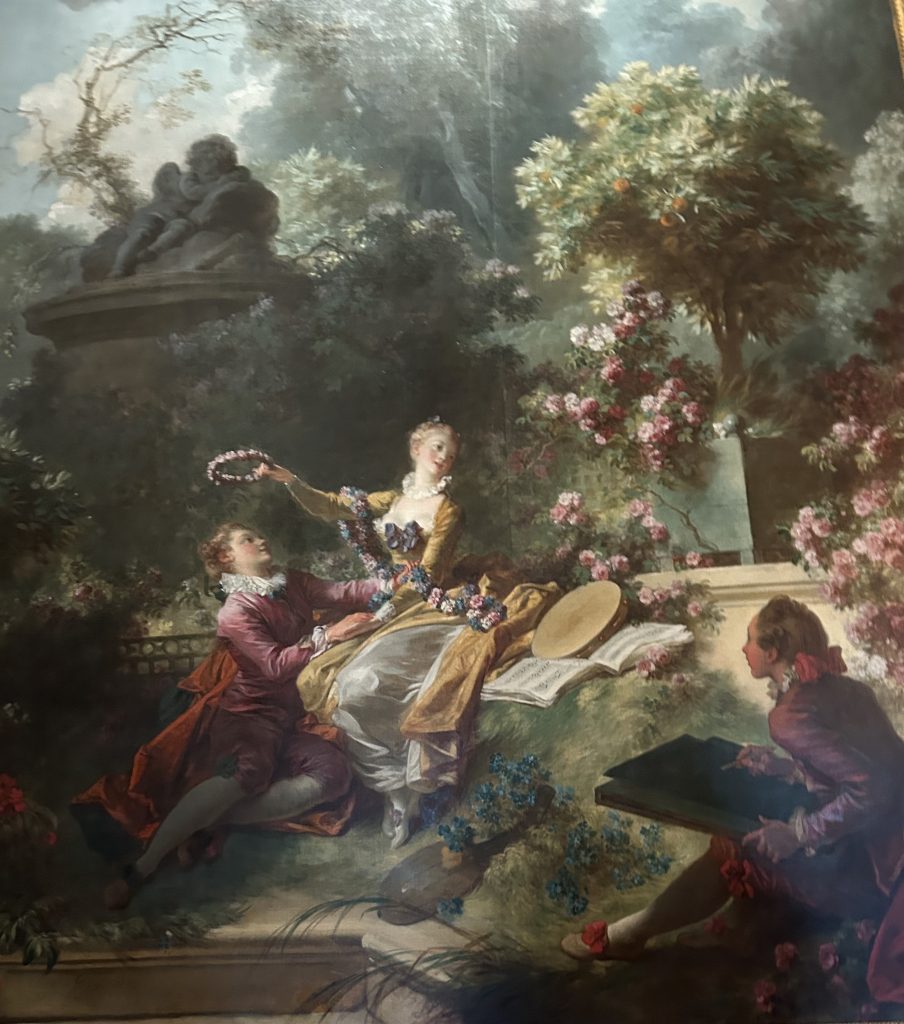
The Fragonard Room was my favorite. It houses Jean-Honoré Fragonard’s The Progress of Love series, large Rococo paintings that cover almost every wall. The scenes are full of movement, color, and a kind of romantic energy that makes the room feel immersive without being overwhelming. Gardens, figures, cupids, silk, everything is painted with a lightness that feels almost weightless.
I found myself returning to it throughout the visit. The room feels almost like stepping into another world, idealized, slightly theatrical, but still quiet in its own way. It is one of the most beautiful rooms I have been in in a museum, not just because of the paintings, but because of how everything comes together. The furniture, the colors, the proportions, it all feels carefully placed.
The Collection
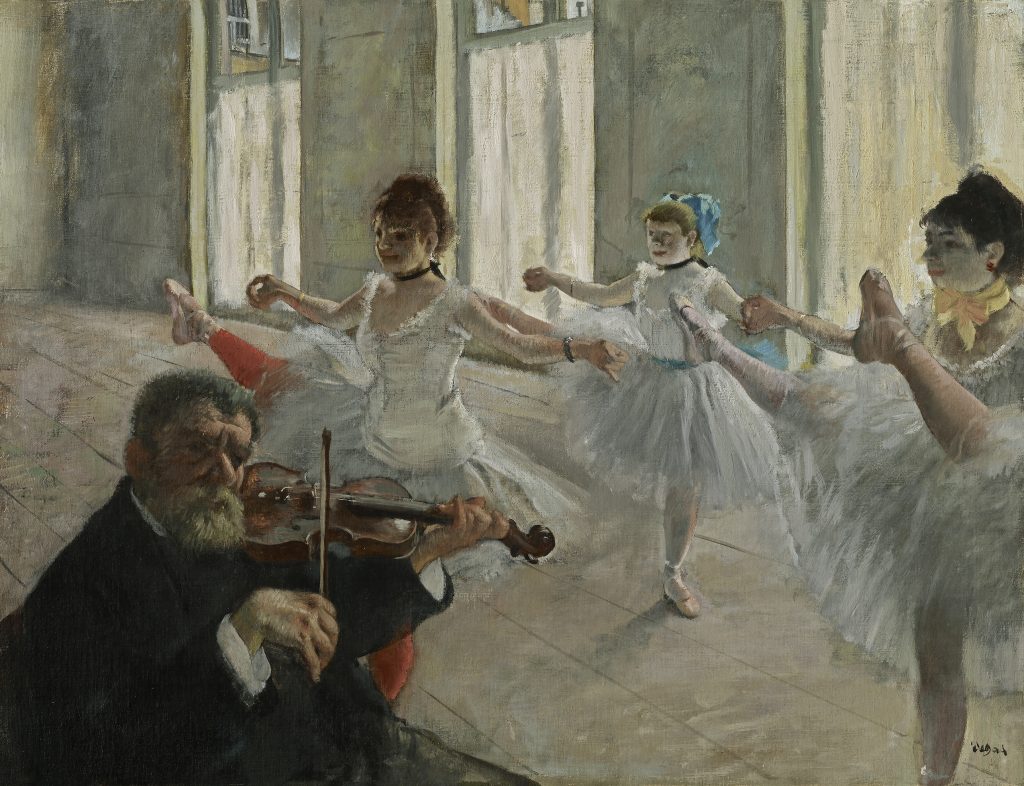
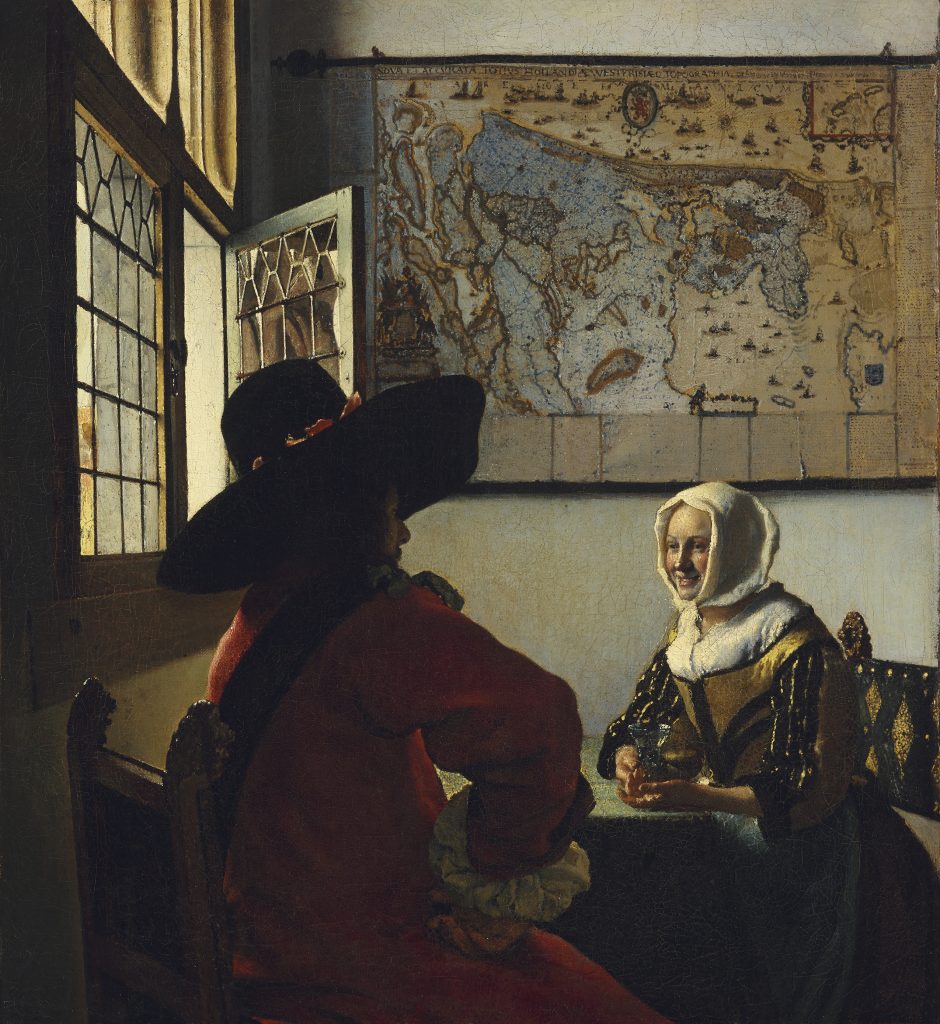
Beyond the rooms themselves, the collection is remarkable. Standing in front of Vermeer’s Officer and Laughing Girl in person, the light, the woman turning toward the officer, the map behind them, felt entirely different from knowing the painting through images. Degas’s The Rehearsal, with its dancers caught mid-movement and its cropped composition, feels unexpectedly intimate in this setting.
Seeing these works in a domestic space changes the experience. Surrounded by furniture and objects, they feel closer. You are not looking at them from a distance, you are in the room with them.
The Gainsborough Exhibition
During my visit, the museum was also hosting Gainsborough: The Fashion of Portraiture, an exhibition focused on his portrait work and its relationship to 18th-century British fashion and society. Gainsborough’s portraits, the way the figures look directly at you, the careful attention to fabric and texture, felt entirely at home in the Frick’s rooms. The Library already includes works by Gainsborough, so seeing more of his paintings in the exhibition felt like a continuation rather than something separate.
Why the Frick Feels Different
The Frick is the kind of place that rewards slow attention. Unlike larger museums, where scale can create distance, the Frick quietly does the opposite. Every room holds something remarkable, and the setting, a Gilded Age mansion with period furniture, porcelain, and decorative arts, shapes the experience in a quiet but noticeable way. Seeing art in a home rather than a gallery makes everything feel closer, and that sense of intimacy changes how you move through it.
I left thinking about how rare it is for a museum visit to feel this way, unhurried, personal, and consistently beautiful from beginning to end. The Frick is one of those places I know I will return to every time I’m in New York.