On design thinking, career uncertainty, and why experimenting with different paths might not be such a bad thing.
I have always admired people who seemed to have everything figured out. The people who knew exactly what they wanted to study, what career they wanted to pursue, and somehow followed a perfectly linear path from a young age. Maybe I admired them so much because I have never really felt that way myself. I have always had different interests, and the idea of choosing only one of them and knowing that was what I wanted to do for the rest of my life has always felt a little overwhelming.
And yet, there seems to be so much pressure to know. Looking back, I think it is pretty absurd that at 18 years old I had to choose a university major that could potentially shape the rest of my career, when the person making that decision was so different from the person I am today. We grow up with this idea that you choose what to study, find a career connected to it, get your first job, and hopefully continue moving forward from there.
I used to think about careers in a much more linear way because of this. There was something reassuring about imagining that if I made the right decisions, eventually everything would fall into place. But the further I have gone with my education and career, the more I have realized that my interests don’t necessarily fit perfectly into one path, and have changed so many different times over the past few years.
I have so many interests, passions, and things I constantly want to learn about. I am interested in education, sustainability, technology, fashion, writing, international work, and probably many other things I will become interested in in the future. For a long time, I think having so many interests made me feel like I needed to figure out which one was the right one. Which one should become my career? Which interests should remain hobbies? And at what point are you supposed to stop exploring and simply decide? I really thought something was wrong with me, especially because I felt like so many people around me had followed a much more linear path and had been doing the same things for years.
This is one of the reasons Designing Your Life by Bill Burnett and Dave Evans stayed with me so much and it is a book I love to return to often.
The book doesn’t really give you an answer to the question of what you should do with your life. Instead, it questions whether finding one perfect answer is even the right way to approach the problem.
Thinking Like a Designer
Burnett and Evans come from Stanford’s design world, and Designing Your Life grew out of a course they developed there. What I didn’t realize before reading more about the book is that they didn’t invent design thinking. They took ideas that had been developing in design for decades and applied them to something much more personal: how we build our lives and careers. Design thinking itself has a much longer history, with roots in work by people such as Herbert Simon and later Stanford’s Product Design program, IDEO, and the Stanford d.school. It has been used to approach everything from products to services and complicated organizational problems. The version that became particularly associated with Stanford emphasizes things like understanding a problem, generating possibilities, building prototypes and testing them rather than expecting the first solution to be perfect.
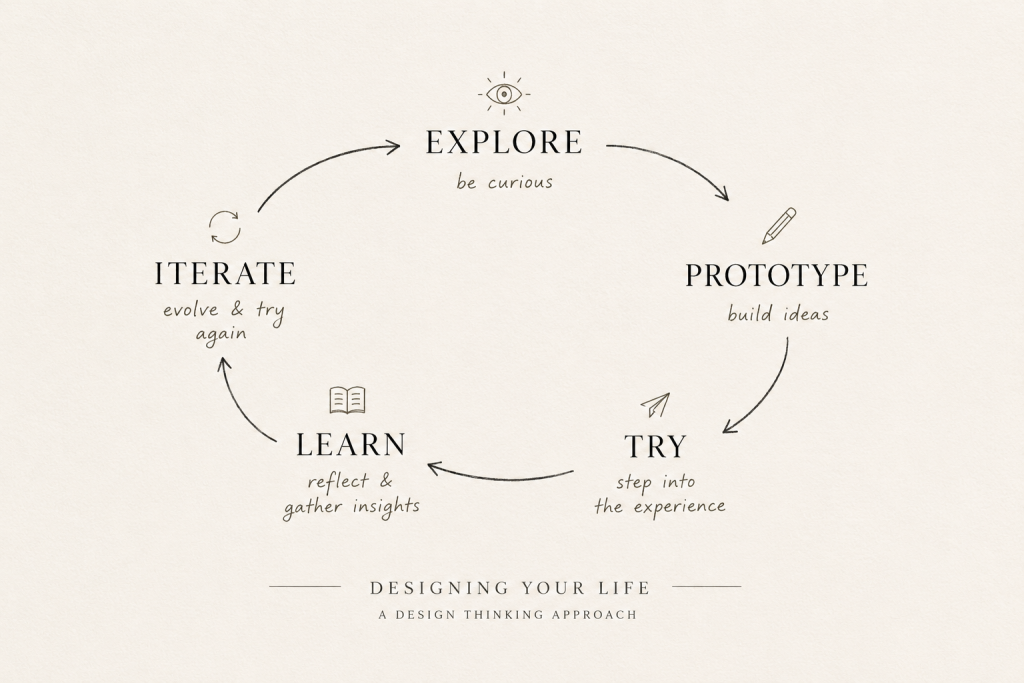
I don’t think we need to become designers to find this useful. What I liked about the book was the idea of applying this same mentality to our own lives and to career development. When someone designs a product, they don’t necessarily sit down on the first day knowing exactly what the finished product is going to look like. They make something, they test it and see what works and what doesn’t. Then they change it.
Yet when it comes to our careers, we often expect ourselves to somehow know the final answer before we have actually experienced it. That was probably one of the biggest ideas I took from the book.
There Might Be More Than One Good Life
Another idea I loved was that there doesn’t necessarily have to be one perfect version of our lives.
The book introduces an exercise called the Odyssey Plan, where you imagine three very different versions of the next five years. The first follows the path you are already on. The second asks what you would do if that path were suddenly unavailable. And the third asks you to imagine what you might do if money or other people’s opinions weren’t part of the equation.
I think this exercise challenges something that is so deeply ingrained in the way we talk about careers: the idea that somewhere out there is the thing we are supposed to be doing. Maybe there isn’t. Maybe there are several lives we could build that would make us happy in completely different ways. I find this idea incredibly reassuring because choosing one possibility doesn’t necessarily mean that every other part of ourselves has to disappear. We can have different careers throughout our lives. We can have interests that become professions and others that remain hobbies. It takes into consideration the human nature, and how we might all change and be different versions of ourselves in the future. Something that matters enormously to us now may become less important later, while something we barely think about today might become central to our lives ten years from now.
When we think about how long a working life actually is, expecting ourselves to choose one identity and remain attached to it forever seems even stranger.
What Does a Good Life Actually Look Like?
Another section that left a profound impact on me was the reflection around our workview and lifeview.
A workview is essentially what you believe about work: why you work, what you think work is for, and what makes work meaningful to you. A lifeview is broader. It asks what matters to you in life and what you believe makes a life meaningful. Burnett and Evans use these together as a kind of compass, with the goal of creating greater coherence between who you are, what you believe, and what you actually do.
I think this is an important distinction because we spend so much time asking people what they want to do and much less time asking what kind of life they actually want to have. And those two are not the same question.
A prestigious career might sound appealing, but perhaps the everyday reality of it leaves very little room for the things you value most. Another job might not have been part of your original plan but gives you the kind of life, relationships, creativity, flexibility, or sense of purpose that actually matters to you.
It made me think more seriously about the role I want work to have in my life rather than only thinking about which job title I want next.
You Don’t Have to Know Before You Try
This was probably the part of the book that affected me most personally. Burnett and Evans talk a lot about prototyping. Instead of making an enormous decision based on what you imagine a career will be like, you find small ways of experiencing it first.
That could mean speaking to someone who already does the work. It could mean taking a class, starting a project, volunteering, trying an internship, or finding another small way of stepping into that world. In the book, it is mentioned how even an informational conversation can function as a prototype because it gives you information you didn’t have before.
I really love this idea because it deeply changed the way I approached some of my own interests. For instance, I have always loved fashion, and recently I started questioning whether maybe I should have done something more fashion-related, while still connecting it to human rights and sustainability, which are areas where I find a lot of meaning and purpose. For a long time, however, I don’t think I really considered the intersection of these interests as something I could explore professionally. After reading Designing Your Life, I started thinking about it differently. I didn’t need to decide whether sustainable fashion was going to become my career but I could simply experiment with it.
So I started looking and applying for opportunities connected to fashion and sustainability, as a way to test whether this was actually something I could enjoy long term. Eventually, I was able to gain experience working in that space and actually see what it felt like rather than continuing to imagine it from the outside.
I think the important part for me was that I wasn’t making some enormous declaration that I had finally discovered what I was meant to do. I was testing an interest. And that took away a lot of the pressure.
The Career We Imagine Versus the Work We Actually Enjoy
This connects to another exercise from the book that I found useful: the Good Time Journal.
The idea is to pay attention to the activities that actually give you energy and engagement, and the ones that drain you. Rather than thinking only in terms of job titles, you begin noticing the individual activities, environments and interactions that make up your days. I think this is particularly helpful because it is very easy to be attracted to the idea of a career. A profession can sound interesting, glamorous, meaningful, prestigious, or perfectly aligned with the identity we have imagined for ourselves.
But do we actually enjoy the work? That is a different question.
Maybe you think you want to work in fashion, but what you really love is writing about fashion. Maybe you imagine yourself working in sustainability but discover that what energizes you most is education or communication around sustainability. Or perhaps you try something you have idealized for years and discover that the everyday reality simply doesn’t suit you.
I don’t think any of those discoveries mean the experiment failed, but rather it means you learned something.
Moving Away From the Idea of One Passion
This is also why I appreciated the book’s criticism of the common advice to simply “follow your passion.”
There is something appealing about that phrase, but it assumes that everyone already has one clearly defined passion waiting to be discovered.
What if you have five?
What if you don’t know what yours is yet?
Burnett and Evans argue for curiosity and experimentation instead. The broader idea is that interests can be developed rather than simply uncovered fully formed, and the book encourages readers to explore possibilities rather than waiting for one perfect calling to reveal itself.
I have become so passionate about Pilates in the past few years, but this probably would have never happened if I hadn’t said yes when a friend invited me to a Pilates class. I had no idea I would love it as much as I did or that it would eventually become such an important part of my routine. It is a simple example, but it made me realize that sometimes we don’t know what we are passionate about until we actually try it.
Sometimes the connections only become visible later.
What If the Prototype Doesn’t Work?
Of course, experimenting also means accepting that some things won’t work. The book treats failure differently from the way we often think about it in careers. If you prototype something and discover that you don’t like it, the prototype has still done its job. It gave you information. The authors connect this way of thinking to developing what they call “failure immunity”: learning from what happens and using that information in the next iteration.
I like this way of looking at experiences that don’t lead where we expected.
A job you don’t enjoy can teach you something about the environment you need. An internship might make you realize that an industry you had idealized isn’t actually for you. Changing direction doesn’t always mean we chose incorrectly before. Sometimes we simply know more now than we did when we made the original decision.
The Privilege of Experimenting
There is one part of this philosophy that I think deserves some caution.
Not everyone has the same freedom to experiment. Some of the criticism around Designing Your Life points out that prototyping careers can assume a certain amount of financial flexibility. Taking an unpaid opportunity, returning to school, accepting a much lower salary, or leaving a secure job simply isn’t realistic for everyone.
I think that’s important to acknowledge. But I also don’t think every prototype has to involve completely disrupting your life. It can be a conversation or an informational interview. It can be reading deeply about an industry, taking one class, starting something on the side, attending an event, volunteering when possible, or creating a small project of your own.
The point isn’t necessarily to take enormous risks. It is to find ways of getting closer to a possibility before deciding what it means for your future.
Not Having It All Figured Out
I still don’t have everything figured out.
There are things I know I care deeply about and others I am still exploring. I don’t know exactly which interests will become central to my career, which ones will intersect with each other, and which ones might simply remain important parts of my life outside of work. But I think Designing Your Life helped me become much more comfortable with that uncertainty.
Instead of constantly asking myself What am I supposed to do?, I am trying to ask smaller questions.
What am I curious about?
What gives me energy?
What would I like to learn more about?
Is there a small way I can try it?
And what did I learn from trying?
There is something freeing about seeing a career this way. It doesn’t have to be one perfectly straight line where every decision makes sense before you make it. Sometimes you take a direction because you are curious, learn something about yourself, and then decide where to go from there.